Puzzles for kids are an easy way to keep children engaged at home while giving them opportunities to think, explore, and solve problems. Classic jigsaw puzzles, matching games and puzzle hunts, are among the many options for toddlers, preschoolers, and school-age children.
The best puzzles are ones that match a child’s age and interests while providing just enough challenge to keep them engaged. Whether you use a puzzle you already have or create a simple activity from materials around the house, puzzle time can easily become part of everyday play. Teachers in Olney often see that children enjoy hands-on activities more when they can choose what interests them and work at their own pace.
Puzzles come in many forms, so families do not have to rely on traditional jigsaw puzzles. Try different types of puzzles to keep children interested and give them opportunities to practice different skills.

Jigsaw puzzles are a classic choice for children of many ages. Choose a puzzle based on your child’s abilities and interests, such as animals, vehicles, nature, characters, or favorite places. Younger children may enjoy puzzles with just a few large pieces, while older children can work on puzzles with more pieces and detailed pictures.
To make puzzle time more engaging, let your child choose the puzzle and work on it together. You can also leave a puzzle on a table and allow your child to return to it throughout the day.
You can easily turn a favorite picture or drawing into a simple homemade puzzle.
Choose a family photo, coloring page, or picture your child has drawn. Attach it to cardstock or cardboard if needed, then cut it into a few large pieces. For younger children, make only a few simple cuts. Older preschoolers can try putting together more pieces or pieces with different shapes.
You can even let your child draw a picture specifically to turn into a puzzle. This adds another creative activity before the puzzle-solving begins.
Learn more in: Creative Learning Activities for Preschoolers in Garrett Park
Matching activities can be turned into simple puzzles using things children are already learning.
For example, preschoolers can match:
You can make your own cards or use matching games you already have at home. Start with a few pairs and add more as your child becomes comfortable.
Letter matching can also be a simple way to reinforce early literacy. You can find more ideas in our article on Easy Alphabet Activities for Preschoolers at Home.

Turn puzzle time into an active game by hiding puzzle pieces around the house. This is a fun option when children need a little movement between quieter activities.
Start by choosing a puzzle with pieces that are easy for your child to find. Hide the pieces in safe and accessible places, then give your child clues or let them search for each one.
Once all the pieces have been found, work together to complete the puzzle.
For younger children, keep the hiding places easy to find. Older children can follow simple clues or complete a small challenge before receiving the next piece.
Floor puzzles are a great option for toddlers and younger children because the large pieces are easier for small hands to handle.
Choose a puzzle featuring something your child enjoys, such as animals, dinosaurs, transportation, numbers, or the alphabet. Spread the pieces out on the floor and let your child explore how they fit together.
For an added challenge, ask questions while they work:
Floor puzzles can also be a fun activity for siblings to complete together.
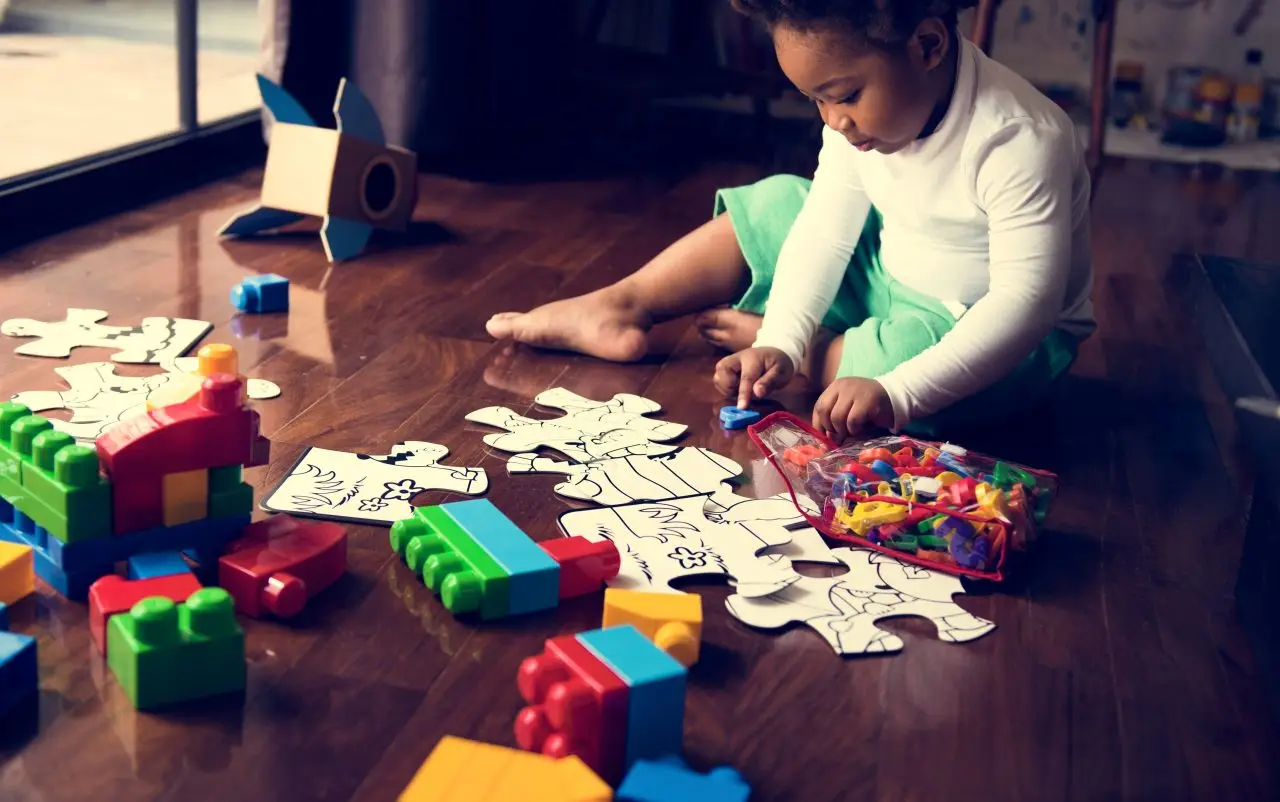
child going easy puzzles for kids floor puzzle
Children have to figure out where pieces belong and try different approaches when something does not fit. This gives them an opportunity to think through a problem, make decisions, and try again.
The process is often just as valuable as completing the puzzle. When a piece does not fit, children learn that they can try a different piece or approach instead of giving up.
Completing a puzzle takes time and attention. Children practice staying focused on a task while working through small challenges.
For younger children, even completing a small puzzle can provide an opportunity to practice sitting with an activity and seeing it through to the end.
Picking up, turning, and placing puzzle pieces requires children to coordinate what they see with how they move their hands.
This is particularly useful for toddlers and preschoolers who are developing control over their hands and fingers. These skills can also support other activities such as drawing, using utensils, and working with classroom materials.
You can find more hands-on ideas in our article on Easy Fine Motor Activities for Toddlers.
Children learn to notice shapes, colors, patterns, and how different pieces relate to one another.
They begin to recognize that a piece needs to be turned a certain way or that two shapes fit together. These experiences encourage early spatial reasoning and can naturally connect to concepts children encounter later in math and science.
Puzzles do not need to be complicated or reserved for special activity time. A few minutes with a favorite jigsaw puzzle, a matching game, or a simple puzzle hunt can give children something interesting to work on at their own pace.
For toddlers and preschoolers, puzzles can introduce colors, shapes, letters, and simple problem-solving. Older children can explore more challenging patterns, pictures, and logic activities. The most important thing is to give children opportunities to explore and figure things out without worrying about getting everything right. When puzzle play feels enjoyable rather than like an assignment, children can build important skills while simply having fun.
For more hands-on learning ideas, explore:
MCCA has been recognized by the Maryland State Legislature for its commitment to Montgomery County issued a quality programs and special needs child care Proclamation in 2016 to MCCA for its commitment to Montgomery County child care for more than 50 years. MCCA was also selected as a 2018 nonprofit finalist for a MOXIE Award for boldness and innovation
MCCA is the oldest nonprofit licensed child care provider in Montgomery County and started its work in 1968 as a Community Action Project of the War on Poverty. Recognizing the need for quality child care programs in their neighborhoods, a group of local activists formed an association to establish centers in Montgomery County that would serve a diverse population and establish high standards for child care. Now, more than 50 years later, MCCA’s dedicated and expertly trained staff continue their tradition of providing high quality child care and play-based education for children.
Families with school aged children who can afford their child care expenses during the school year often struggle to afford the all-day programs they need when school is out for the summer. The Richard Krampf Summer Adventures Scholarship Fund was established to help provide children a safe and stimulating place to spend their weeks when school is out. Please contact an MCCA Director for details on how to apply.