
Block play is much more than stacking blocks and building towers. When children build, knock down, rebuild, and experiment with different structures, they are exploring ideas about space, balance, problem-solving, and creativity through hands-on play.
Block play can grow with children and provide new challenges as their skills develop. It is also an activity that requires very little setup, making it easy to incorporate into everyday play at home.
Teachers in Rockville often see children become deeply engaged when they have the freedom to build, experiment, and create something of their own.

Building does not always go according to plan. A tower may fall, a bridge may not hold, or a structure may not have enough room for another block.
Instead of simply correcting the problem for them, give children time to figure out what they could change.
You might ask:
These simple questions encourage children to think through problems and test their own ideas.
Blocks do not have to be used in only one way. A collection of blocks can become a house, a castle, a garage, a road, or an entirely imaginary world. Give children time to decide what they want to create without providing too many instructions. Open-ended building allows children to make their own choices and turn their ideas into something they can see and interact with.
This connects naturally with imaginative play. You can find more ideas for encouraging creativity in our article 7 Imagination Activities for Children That Encourage Creativity and Learning.
Block play naturally introduces children to early math concepts.
As children build, they may practice:
For example, ask your child whether their tower is taller or shorter than another structure. You can also count how many blocks they used or see how many more blocks they need to make two towers the same height.
You can learn more about developing early math skills through play in How Play Builds Early Math Skills for Preschoolers.

Children are constantly thinking about where objects fit when they build.
They learn through questions such as:
These experiences help children understand position, size, direction, and how different objects relate to one another. Even simple activities like stacking blocks or lining them up give younger children opportunities to explore these concepts.
Picking up blocks, turning them, stacking them, and carefully placing one block on top of another requires hand control and coordination.
Toddlers can begin with large blocks that are easy to grasp. As children become more comfortable, they can work with smaller pieces and more complicated structures.
Block play can also be a natural way to practice patience. Children have to slow down and carefully place pieces when they are trying to build something that will stay standing.
You do not need a large collection of specialty building toys to encourage block play. Start with whatever building materials your child already enjoys.
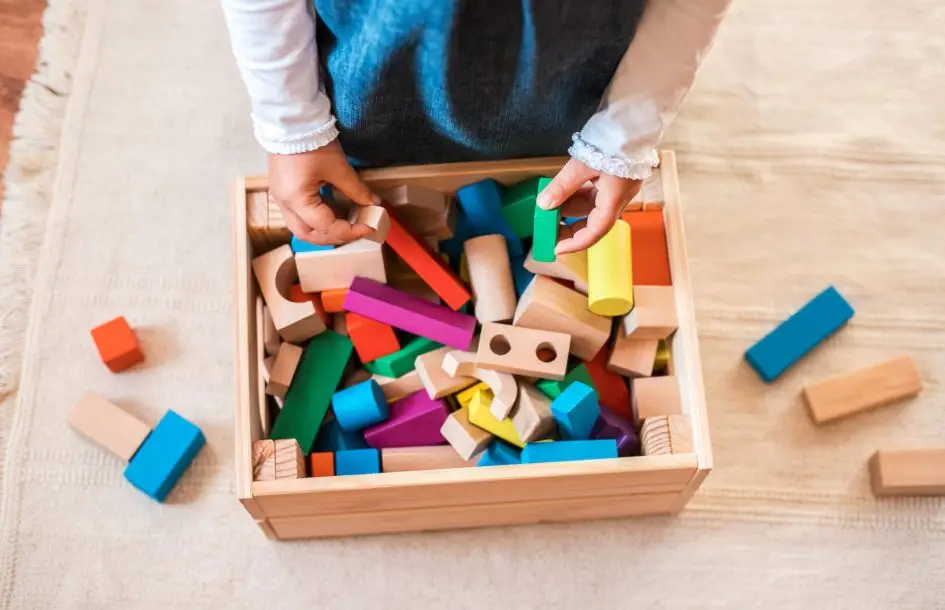
Wooden blocks, plastic blocks, magnetic tiles, cardboard pieces, and other construction materials can all provide opportunities for building.
Try keeping building materials somewhere children can easily reach them. When blocks are available for independent play, children can return to their structures throughout the day and continue developing their ideas.

Sometimes the most valuable part of block play happens when something goes wrong.
A tower that falls gives children an opportunity to figure out why it happened and decide what to try next. They may discover that a wider base creates more stability, that certain blocks work better underneath heavier ones, or that adding too many pieces at once makes a structure unstable.
Instead of treating a fallen structure as a failure, parents can encourage children to view it as part of the building process.
Try saying:
This approach gives children opportunities to practice persistence and learn that experimenting is part of solving problems.
Block play does not need a lesson plan or a specific end result. Children can learn simply by building, experimenting, knocking down structures, and trying again.
Whether a toddler is stacking three blocks or an older child is designing an entire city, the process gives children opportunities to practice problem-solving, creativity, early math, spatial awareness, coordination, and cooperation.
For more play-based learning ideas, explore:
MCCA has been recognized by the Maryland State Legislature for its commitment to Montgomery County issued a quality programs and special needs child care Proclamation in 2016 to MCCA for its commitment to Montgomery County child care for more than 50 years. MCCA was also selected as a 2018 nonprofit finalist for a MOXIE Award for boldness and innovation
MCCA is the oldest nonprofit licensed child care provider in Montgomery County and started its work in 1968 as a Community Action Project of the War on Poverty. Recognizing the need for quality child care programs in their neighborhoods, a group of local activists formed an association to establish centers in Montgomery County that would serve a diverse population and establish high standards for child care. Now, more than 50 years later, MCCA’s dedicated and expertly trained staff continue their tradition of providing high quality child care and play-based education for children.
Families with school aged children who can afford their child care expenses during the school year often struggle to afford the all-day programs they need when school is out for the summer. The Richard Krampf Summer Adventures Scholarship Fund was established to help provide children a safe and stimulating place to spend their weeks when school is out. Please contact an MCCA Director for details on how to apply.