
Learning how to wait their turn is an important part of early childhood development. For young children, waiting can be surprisingly difficult. They may want the same toy as a sibling, become frustrated when another child gets picked first, or interrupt a conversation because they have something exciting to share. These moments are common as children learn to manage their impulses, understand other people’s needs, and cope with frustration.
The good news is that helping children wait their turn doesn’t require long lessons or complicated activities. Parents and caregivers in Olney can teach patience through everyday routines, simple games, and calm reminders. With consistent practice, children can begin to understand that other people deserve a chance to participate, and their own turn will come, too.
Preschoolers are still developing impulse control, emotional regulation, and an understanding of other people’s perspectives. When a child sees a favorite toy or wants to answer a question, the desire to act immediately can be stronger than their ability to pause and wait.
Turn-taking also helps children build relationships. When children learn to wait, listen, and give others opportunities to participate, they develop skills that support cooperation and friendship.
For more insight, read: 8 Essential Social Skills Your Child Will Learn in Preschool.
Expecting a young child to wait several minutes without support can be overwhelming, especially when they’re excited about an activity. Instead, begin with short, manageable periods and gradually increase the waiting time as your child becomes more comfortable.
For example, if your child asks for a snack while you’re finishing a task, you might say, “I’ll get your snack as soon as I put this away. Can you wait while I finish?” Start with a brief delay that your child can reasonably manage. When they succeed, acknowledge their effort.
The important part is making the wait achievable. If your child struggles, shorten the time and try again later. Small successes help children understand that waiting is something they can learn to do.
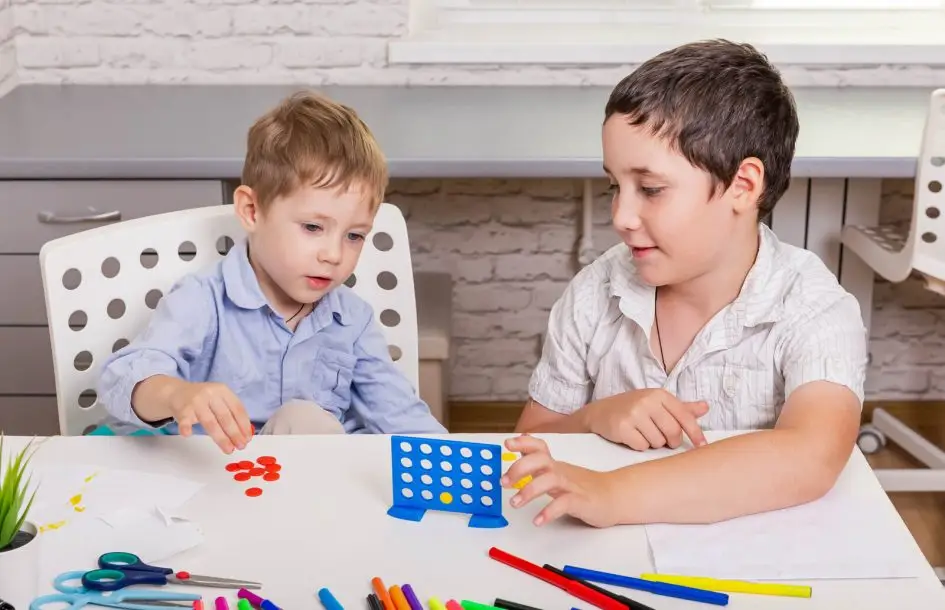
Games make waiting feel like a natural part of having fun rather than a rule imposed by an adult. Choose activities where everyone gets an opportunity to participate and the sequence is easy to understand.

Try these simple ideas at home:
Roll a ball back and forth: Explain that one person rolls the ball and the other person rolls it back.
Build a tower together: Take turns adding one block at a time.
Play a simple board game: Help your child follow the order of play and wait until their name or turn comes up.
Take turns adding to a drawing: Each person adds a shape, line, or picture before passing the paper.
Play a movement game: Take turns choosing an animal to imitate, a dance move, or a way to move across the room.
Keep the games short at first, and choose activities that match your child’s age and interests. If a game becomes frustrating, simplify the rules or return to an easier activity.
Children in Olney preschools and other early learning settings can practice similar skills during group play, but families don’t need special materials to reinforce them at home. Everyday games provide plenty of opportunities to practice cooperation and patience.
Young children may understand that they need to wait without knowing exactly what waiting looks like. Vague instructions such as “Be patient” or “Stop grabbing” don’t always tell them what to do instead.
Use short, specific phrases that explain what will happen next:
Consistent language helps children recognize the pattern. Over time, they may begin using these phrases themselves when playing with siblings or friends.
It’s also helpful to follow through on what you say. If you promise that your child can have a turn next, try to make that happen when the current turn ends. Children are more likely to trust the process when they know their opportunity won’t be forgotten.
Waiting is harder when children have nothing to focus on. A child standing behind another person may become restless simply because they don’t know what to do with themselves. Give your child a small activity that keeps them involved without taking over someone else’s turn.
For example, while waiting for a sibling to finish a puzzle, your child could choose which puzzle to do next. At the playground, they might count the children ahead of them before using the slide. While waiting for a family member to finish speaking, they can think about the story they want to share.
You can also encourage children to watch what someone else is doing. When playing a game, ask, “What move do you think she’ll make?” or “Can you see how he is building his tower?”
Time can be an abstract concept for preschoolers. Telling a child to wait two minutes may not help if they don’t yet understand what two minutes feels like.

A visual timer, sand timer, or simple picture card can make waiting easier to understand. Visual cues can also be useful during routines. A child waiting for a turn to wash their hands might stand on a designated spot or hold a picture card showing the next step.
Educators in Olney and throughout Montgomery County can use predictable routines and visual reminders to support children’s participation in group activities. Parents can adapt the same general idea at home, adjusting the tool and waiting time to fit their child’s needs.
Children learn a great deal by observing how adults interact with others. When family members take turns speaking, listen without interrupting, and allow others to participate, children see what respectful turn-taking looks like.
Try modeling these behaviors throughout the day:
Learning to wait their turn helps children develop patience, self-control, communication, and the social skills they need to play and learn with others. These abilities grow through repeated experiences, not through one conversation or a single successful game.
The goal isn’t to make children wait without complaining every time. It’s to help them learn that other people get turns, their feelings matter, and their own opportunity will come. With practice and encouragement, waiting can become a little easier one turn at a time.
Learn more in:
MCCA has been recognized by the Maryland State Legislature for its commitment to Montgomery County issued a quality programs and special needs child care Proclamation in 2016 to MCCA for its commitment to Montgomery County child care for more than 50 years. MCCA was also selected as a 2018 nonprofit finalist for a MOXIE Award for boldness and innovation
MCCA is the oldest nonprofit licensed child care provider in Montgomery County and started its work in 1968 as a Community Action Project of the War on Poverty. Recognizing the need for quality child care programs in their neighborhoods, a group of local activists formed an association to establish centers in Montgomery County that would serve a diverse population and establish high standards for child care. Now, more than 50 years later, MCCA’s dedicated and expertly trained staff continue their tradition of providing high quality child care and play-based education for children.
Families with school aged children who can afford their child care expenses during the school year often struggle to afford the all-day programs they need when school is out for the summer. The Richard Krampf Summer Adventures Scholarship Fund was established to help provide children a safe and stimulating place to spend their weeks when school is out. Please contact an MCCA Director for details on how to apply.