
Sunny days and curious minds make summer the perfect season for hands-on discovery. Science experiments can turn your home, or our Rockville preschool, into a mini laboratory. With a few simple supplies and a little creativity, science experiments can fuel your child’s imagination while reinforcing early learning. These fun, safe activities build early learning skills through play, whether you’re outside in the backyard or indoors on a rainy day.

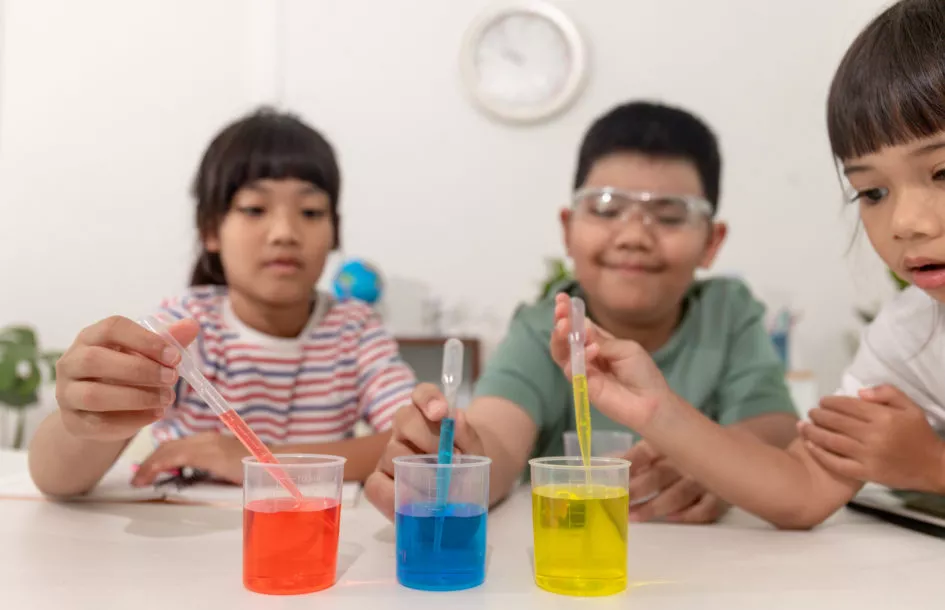
Fill six cups with three of them halfway full of water. Add red, yellow, and blue food coloring to the filled cups and place them in a line, alternating with empty cups. Fold paper towels into strips and place one end in a full cup and the other end in an empty one next to it.
Now, wait and watch! Over the next hour, the colored water will “walk” up and over the paper towels into the empty cups, creating new colors in the process. This activity is a colorful introduction to capillary action and how primary colors combine to form secondary ones; always a favorite in classrooms like this Rockville preschool.
Grab a few small plastic dinosaurs or toys and freeze them in containers of water overnight. In the morning, set the frozen blocks outside or in a bin, and give your child tools like salt, warm water in a dropper, or even a spoon to help them excavate the toys.
This sensory experiment mimics the work of paleontologists, encouraging patience, observation, and fine motor skills. On hot days, it also doubles as a refreshing sensory experience; something often explored in programs like this early childhood center in Gaithersburg.
Take an empty plastic bottle and cut off the bottom. Slide a clean sock over the cut end and secure it with a rubber band. In a shallow dish, mix water with dish soap (and a few drops of food coloring if you like). Dip the sock-covered end into the soap mixture.
Then, blow through the mouthpiece and watch as long, foamy bubbles snake out! This outdoor-friendly activity teaches airflow, surface tension, and makes for giggly, foamy fun.
Fill a shallow dish with water and sprinkle a thin layer of ground black pepper across the top. Invite your child to observe how the pepper floats calmly on the surface.
Now for the magic: have your child dip a fingertip into dish soap and gently touch the center of the water. In an instant, the pepper shoots away from their finger and scatters to the edges of the dish.
This eye-catching experiment is a simple way to demonstrate surface tension; and why soap is so effective at breaking it. It’s a great introduction to how water molecules behave and is often used in early learning programs to spark awe and conversation around everyday science.
Supervision and simplicity are key. Choose non-toxic materials and keep steps short and interactive. At child care centers like this Rockville preschool, educators often guide children through hands-on experiments that include mixing, pouring, and observing.

Science builds curiosity, persistence, and communication skills. Preschoolers who ask questions, make guesses, and test ideas are practicing foundational skills for reading, math, and problem-solving.
Let your child take the lead. Ask what they think will happen, encourage them to record what they see with pictures or words, and let them choose what to test next. These small actions boost confidence and help them see themselves as young scientists.
Science isn’t just for older students; it starts with wonder. Early exposure to STEM helps children build the skills and confidence they’ll use in school and life. Whether you’re conducting experiments at home or attending a local program like this one in Rockville, supporting your child’s natural curiosity is one of the best things you can do for their development.
Want more ways to inspire learning this summer?
Explore our other posts on How Outdoor Observation Sparks Curiosity and Learning in Preschoolers and Fun Science Experiments to Try with Your Kids This Summer.
MCCA has been recognized by the Maryland State Legislature for its commitment to Montgomery County issued a quality programs and special needs child care Proclamation in 2016 to MCCA for its commitment to Montgomery County child care for more than 50 years. MCCA was also selected as a 2018 nonprofit finalist for a MOXIE Award for boldness and innovation
MCCA is the oldest nonprofit licensed child care provider in Montgomery County and started its work in 1968 as a Community Action Project of the War on Poverty. Recognizing the need for quality child care programs in their neighborhoods, a group of local activists formed an association to establish centers in Montgomery County that would serve a diverse population and establish high standards for child care. Now, more than 50 years later, MCCA’s dedicated and expertly trained staff continue their tradition of providing high quality child care and play-based education for children.
Families with school aged children who can afford their child care expenses during the school year often struggle to afford the all-day programs they need when school is out for the summer. The Richard Krampf Summer Adventures Scholarship Fund was established to help provide children a safe and stimulating place to spend their weeks when school is out. Please contact an MCCA Director for details on how to apply.