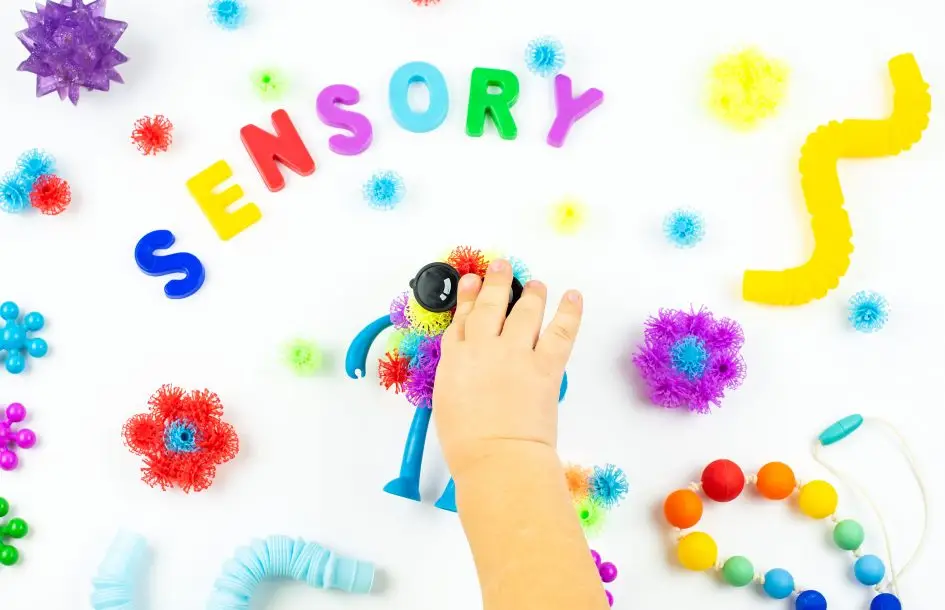

Sensory activities for babies are one of the simplest ways to support early development, and most of them do not require special toys, planned lessons, or a set schedule. Babies learn about the world by touching, looking, listening, tasting, and moving, and everyday moments already give them plenty of opportunities to do all of it.
Before babies can talk, walk, or follow instructions, they are gathering information through their senses. A crinkly page, a caregiver’s voice, a soft blanket, and the feeling of being carried are all experiences that help babies begin to make sense of their surroundings.
Sensory play can give babies opportunities to develop:
Sensory play is any activity that gives a baby a chance to explore through their senses. For infants, this usually looks less like a structured activity and more like an invitation to notice something new.
A baby who is running their hand over a textured blanket, watching a caregiver’s face, turning toward a familiar voice, or kicking their legs during a diaper change is already engaged in sensory exploration.
Because babies develop at different rates, sensory play tends to work best when it follows the baby’s lead. Some infants enjoy long stretches of exploring one object. Others prefer short bursts of activity followed by rest.
Sensory experiences give babies information they will use to build later skills.
Reaching for a rattle helps a baby practice coordinating what they see with what their hands do, an early step toward the fine motor skills they will use later for drawing, cutting, and writing. Feeling different textures gives babies experience with a wider range of sensations. Hearing a caregiver name what is happening supports early language. Moving during tummy time builds the neck, shoulder, and core strength babies need before rolling, sitting, and crawling, which is where gross motor skills begin.
Educators in Rockville often point out that sensory activities for babies do not need to be elaborate to be valuable. The goal is not to entertain a baby, but to give them safe opportunities to explore at their own pace.
The sensory activities for babies below use simple materials most families already have. Every one of them requires close, hands-on supervision, and anything small enough to fit in a baby’s mouth should be kept out of reach.

Babies explore texture with their hands, feet, and mouths, so materials should always be too large to be a choking hazard.
Try:
Newborns see high-contrast patterns most clearly, and their vision develops steadily over the first year.
Try:
Everyday sound is one of the richest sensory experiences babies have.
Try:
Movement helps babies build strength and learn where their body is in space.
Try:
As babies get stronger and more mobile, many of these grow into indoor play ideas that build motor skills for older infants and toddlers.
There is no set amount. Many babies do best with brief activities offered several times a day rather than one long session.
Babies also communicate when they have had enough. Turning away, fussing, arching the back, yawning, or losing interest can all be signs that a baby needs a break. Following those cues is part of the activity, not an interruption to it.
Rest matters just as much as stimulation. A quiet, calm period after active play gives babies time to process what they have just experienced, and short stretches of independent play can be part of that.

A few habits keep sensory play safe for infants:
Parents comparing infant and toddler programs, including those in Rockville, can ask how sensory experiences fit into the daily routine.
Helpful questions include:
It is also worth observing the room itself. Are the materials clean, age-appropriate, and within reach? Do caregivers talk and sing with babies during ordinary routines? A room that supports sensory exploration usually looks calm and unhurried rather than crowded with toys.
Sensory activities for babies work best when they fit into the rhythm of the day rather than competing with it. Feeding, diaper changes, tummy time, bath time, and quiet moments together already give babies dozens of chances to touch, listen, look, and move.
Parents do not need a plan or a shelf of new toys to support this kind of learning. Noticing what interests your baby, offering a safe way to explore it, and following their cues about when to stop is usually enough.
For more early learning ideas, explore:
MCCA has been recognized by the Maryland State Legislature for its commitment to Montgomery County issued a quality programs and special needs child care Proclamation in 2016 to MCCA for its commitment to Montgomery County child care for more than 50 years. MCCA was also selected as a 2018 nonprofit finalist for a MOXIE Award for boldness and innovation
MCCA is the oldest nonprofit licensed child care provider in Montgomery County and started its work in 1968 as a Community Action Project of the War on Poverty. Recognizing the need for quality child care programs in their neighborhoods, a group of local activists formed an association to establish centers in Montgomery County that would serve a diverse population and establish high standards for child care. Now, more than 50 years later, MCCA’s dedicated and expertly trained staff continue their tradition of providing high quality child care and play-based education for children.
Families with school aged children who can afford their child care expenses during the school year often struggle to afford the all-day programs they need when school is out for the summer. The Richard Krampf Summer Adventures Scholarship Fund was established to help provide children a safe and stimulating place to spend their weeks when school is out. Please contact an MCCA Director for details on how to apply.